Inspection Report: The Framework for Deciding When a Staple Is Beyond Repair
Photo: el cajon yacht club, CC BY 2.0, via Wikimedia Commons
Every city has that one building. Structurally significant, historically beloved, and quietly failing behind its façade. Inspectors walk through with clipboards, tag what can be saved, and deliver a verdict the owner has been avoiding for years: restore or demolish.
Your closet has its own version of that building. The blazer that carried you through three job interviews. The leather jacket with a patina you describe as "character." The denim that fits like nothing else on earth and looks like nothing you'd admit to in daylight.
The instinct is always to repair. But repair, like renovation, has limits. Knowing where those limits sit is the difference between a wardrobe that endures and one held together by sentiment and safety pins.
The Structural Assessment
Before any decision, an inspector distinguishes between cosmetic damage and structural failure. Clothing demands the same discipline.
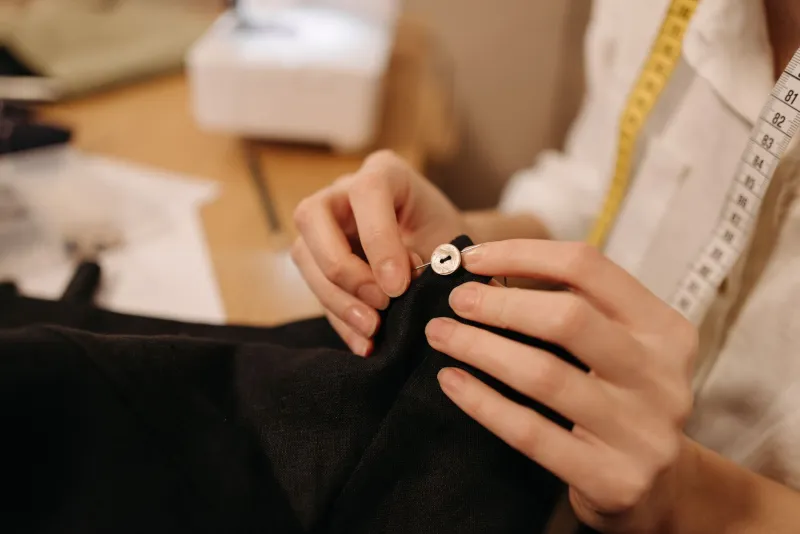
Cosmetic issues — a missing button, a scuffed toe, a hem that has surrendered — are surface-level. They affect appearance, not integrity. These are paint jobs and fixture swaps. Handle them and move on.
Structural issues are different. Thinning fabric at high-stress points, collapsed shoulder seams, linings that have disintegrated into powder, soles worn through to the footbed, elasticity that no longer returns. When the material itself is failing — not the finishing, but the foundation — you are no longer maintaining a garment. You are postponing a demolition.
Run this simple audit on the piece in question:
- The light test. Hold the highest-stress areas (elbows, knees, seat, underarms) up to a window. If light passes through fabric that used to be opaque, the fibers are spent.
- The recovery test. Stretch any ribbing, elastic, or knit gently. If it doesn't rebound, the structure is compromised.
- The seam test. Inspect stitching where panels meet. Multiple failed seams in different locations suggest the thread and fabric are aging together — a systemic problem, not a local one.
- The smell test, literally. Odors that persist after cleaning indicate breakdown in the fibers themselves.
Two or more failures typically mean the garment is load-bearing in name only.
The Cost-Benefit Ledger
Contractors live by a rule: never sink renovation money into a building whose foundation is gone. Fashion deserves the same arithmetic.
Start with repair cost. Resoling quality Goodyear-welted boots at a cobbler might run $80 to $120 — a sound investment in a $400 pair. Replacing a zipper on a well-made jacket is routine maintenance. These are permits, not renovations.
Then weigh the replacement cost of an equivalent garment. If a $75 repair buys five more years from a piece that would cost $300 to replace well, the ledger is clear. If the same repair goes into a $40 fast-fashion knit whose fabric is already pilling beyond rescue, you've paid to extend the life of something that has none left.
There's a third column people forget: hidden costs. A failing garment doesn't just look worse — it performs worse. A compromised winter coat that no longer blocks wind costs you comfort every cold morning from Minneapolis to Manhattan. A stretched-out waistband quietly changes how you carry yourself. Depreciated performance is a real expense.
Emotional Zoning Laws
Here is where wardrobes diverge from buildings: you have feelings about your clothes, and no inspector can overrule them. What you can do is zone those feelings properly.
Some pieces earn heritage status. A grandfather's tweed coat, a wedding suit, a jacket worn across a decade of your life — these carry value no spreadsheet captures. But heritage zoning has rules. A protected piece belongs in preservation, meaning stored well, worn on occasion, and repaired only in ways that honor its construction. It does not belong in daily rotation, absorbing commute wear it can no longer survive.
The dangerous zone is what we'd call sentimental squatting: garments kept not for their history or utility but because letting go feels like waste. These occupy prime closet real estate while contributing nothing. Every hanger they hold is a hanger denied to something that works.
The test is simple. If you haven't worn it in a year, and the reason is that you can't — not won't — it isn't a staple anymore. It's a monument.
The Demolition Order
When the verdict is clear, execute it with the same intention you'd bring to any teardown.
First, salvage materials. Quality buttons, zippers, and hardware can be harvested by a tailor and reused. Some fabrics can be repurposed entirely — a shirting cotton becomes pocket squares; sound denim becomes a tote.
Second, consider the resale and donation channels that fit the garment's condition. Pieces with structural life left belong with consignment or donation programs; truly spent textiles belong in textile recycling, not the landfill. Many US municipalities now accept textiles curbside or at drop-off sites.
Third — and this is the step most people skip — document what the garment did for you. Fit, weight, fabric, why it worked. That record becomes your specification sheet for the rebuild. The best renovations aren't imitations of what stood before; they're better-informed versions of it.
Building Back
A demolition is only successful if something worth having rises in its place. Use the vacancy in your closet as an opportunity to buy the corrected version: the coat with the storm collar the old one lacked, the trousers in the fabric weight you now know you prefer.
Structures fail. That's not a design flaw — it's a reason building codes exist. The wardrobe that lasts isn't the one where nothing ever gets torn down. It's the one where every teardown is deliberate, every rebuild is smarter, and nothing is left standing on sentiment alone.
Inspect honestly. Renovate wisely. Demolish without apology.