Steel in the Seams: How Five American Landmarks Walked the Runway Before You Did
Architecture and fashion share a confession neither likes to admit: the best of both begins with structure. Long before a garment reaches a fitting room, someone has made decisions about load, tension, and proportion that mirror the choices an architect makes before a single girder is set. Across American cities, a handful of buildings have shaped collections so thoroughly that their influence now hangs, quite literally, in retail windows from New York to Los Angeles.
The Seagram Building and the Power of Restraint
Mies van der Rohe's 1958 masterpiece on Park Avenue taught fashion the same lesson it taught skyline: authority comes from discipline. The building's bronze mullions and precisely spaced I-beams inspired a generation of tailoring defined by clean verticality—think columnar sheath dresses, unbroken front closures, and suiting that resists ornament the way the Seagram resists clutter.
To translate it into a working wardrobe, start with a single dark column dress or a sharply pressed wool trouser. The point is not minimalism as an aesthetic pose; it is the confidence that comes when every line earns its place.
Fallingwater and the Cantilevered Silhouette
Frank Lloyd Wright's Pennsylvania masterwork daringly suspends its terraces over a waterfall, and fashion has borrowed that audacity repeatedly. Off-the-shoulder necklines, extended shoulder seams, and asymmetric peplums all perform the same trick: weight that appears to float without visible support.
The wearable version requires an honest foundation. A cantilevered piece—say, an asymmetric blouse with a dramatic extended shoulder—needs anchoring at its opposite end. Pair it with a fitted column skirt or slim trouser, and the composition holds. Skip the anchor, and the whole thing tips over visually.
The Walt Disney Concert Hall and Fabric as Curvature
Frank Gehry's Los Angeles landmark proved that rigid materials could move. Its stainless-steel sails, which catch California light differently at every hour, reshaped how designers think about draping. The result shows up in fluid bias-cut gowns, sculpted neoprene bodices, and pleated pieces that ripple like sheet metal caught mid-bend.
The lesson for the everyday wearer: motion is structure. A single curved element—a rounded hem, a spiral wrap dress—introduces energy into an outfit without a single embellishment.
The Flatiron Building and the Geometry of Presence
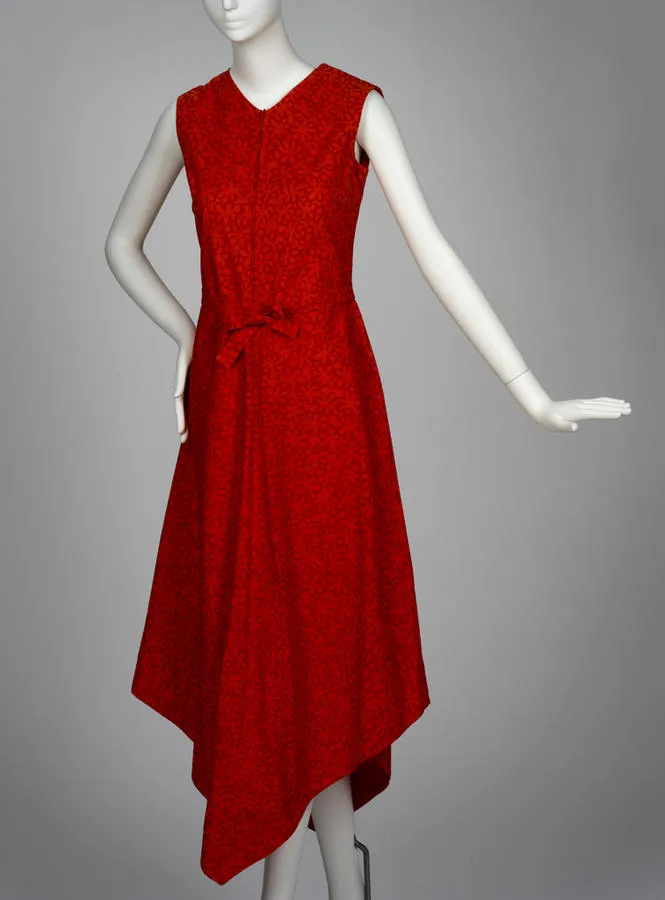
New York's wedge-shaped icon demonstrates that constraint produces character. Squeezed onto a triangular lot, it became one of the most photographed buildings in America precisely because its shape is unrepeatable. Fashion's answer is the angular garment: origami-folded jackets, triangular panel skirts, and color-blocked pieces that use hard edges as decoration.
Wear it by committing to one strong geometric statement per outfit. A sharply angled blazer over soft, fluid separates creates the same tension the Flatiron creates against the Manhattan grid.
The Golden Gate Bridge and the Engineering of Span
San Francisco's suspension bridge contributes something subtler than shape: the concept of span. Its cables distribute enormous forces across open space, and fashion borrows that logic in draped necklines, cold-shoulder cutouts, and strappy designs where fabric crosses unsupported distance.
The practical takeaway is about tension. Garments that bridge open space—a halter dress, a cutout midi—rely on precise fit at the anchor points. Get the shoulders and waist right, and the span between them looks effortless. Get them wrong, and no amount of styling saves it.
Building Your Own Blueprint
None of this requires dressing head-to-toe in architectural homage. The strongest wardrobes borrow one structural idea at a time: a cantilevered shoulder here, a columnar line there, a single curve doing the work of a dozen accessories. American buildings endured because their designers understood what holds things up. The same standard separates clothing that lasts a season from clothing that defines one.