Extended Beyond Support: The Quiet Physics of the Asymmetric Hem
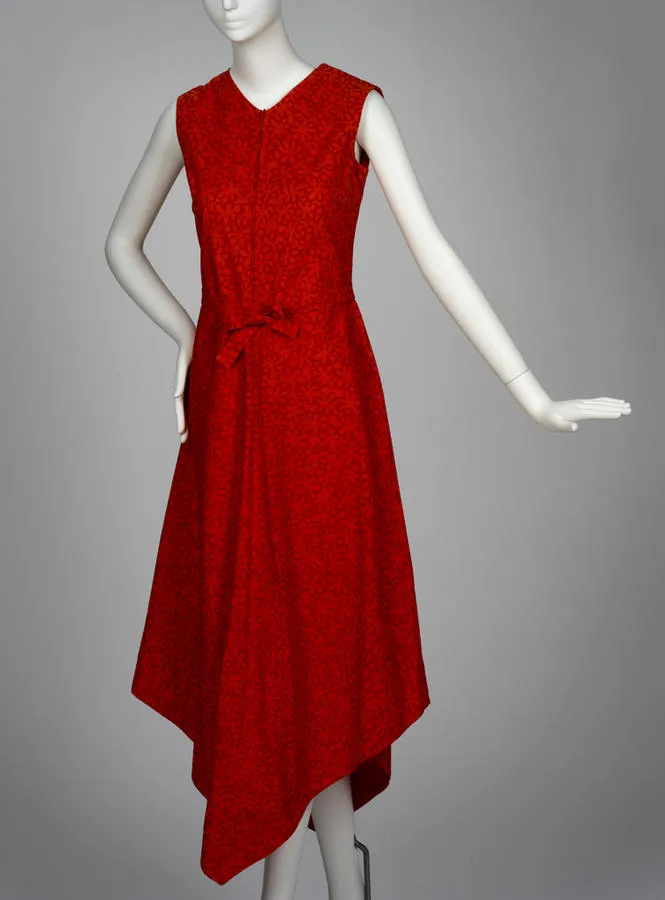
Photo: Photographer for the Rhode Island School of Design Museum of Art, CC0, via Wikimedia Commons
In structural design, the cantilever is an act of audacity: a beam anchored at only one end, stretching into open space as though gravity were negotiable. Think of Frank Lloyd Wright's Fallingwater, its terraces hovering over a Pennsylvania stream, or the declare-it-loud balconies of mid-century American civic buildings. The principle is simple and slightly defiant—weight extended beyond its support, held in place by counterforces hidden from view.
Fashion has its own version of this maneuver. The asymmetric hem, the single-shoulder top, the diagonal seam that slices a dress from collarbone to knee—each is a garment extending visual weight past its natural anchor point. And like their architectural counterparts, these pieces succeed or fail on the quality of their hidden counterbalance.
Why Off-Balance Reads as Intentional
The human eye is a pattern-seeking instrument. When a hemline breaks from horizontal symmetry, the brain registers tension—a question that demands resolution. This is precisely why asymmetric cuts command attention in a way that even the most immaculate symmetric tailoring cannot. They introduce a single point of instability into an otherwise stable composition.
But tension without resolution reads as error, not design. The difference between a hemline that looks sculptural and one that looks accidental comes down to everything else in the outfit doing the work of a foundation. In building terms: the cantilevered floor plate is only as convincing as the anchored core holding it aloft.
The Styling Formulas
The Single-Axis Rule. Allow one axis of asymmetry per outfit. A diagonal-hem skirt pairs with a structured, symmetric top—a clean boatneck, a boxy cropped jacket. Two competing diagonals fragment the silhouette instead of anchoring it.
Weight Where the Anchor Sits. If your garment extends volume to one side—a draped one-shoulder top, an elongated asymmetric lapel—counterweight it with substance on the opposite side. A tailored blazer with a strong shoulder line, a structured bag carried on the lighter side, or a crisp wide-leg trouser all serve as ballast. The goal is for the eye to feel the balance even if it cannot articulate why.
Ground the Cantilever. Architectural cantilevers resolve into a massive base. In dressing terms, this means footwear with visual weight: a substantial boot, a chunky loafer, a block heel. A delicate slingback under a dramatic diagonal-hem midi is a building on a foundation of sand.
Restraint in the Periphery. Asymmetry is a loud statement delivered in a single gesture. Keep color palettes restrained—tonal dressing, in particular, lets the cut itself carry the drama—and skip additional structural theatrics like exaggerated sleeves or cutouts in the same look.
The American Off-Kilter Tailoring Movement
A wave of US-based designers has made calculated imbalance a signature rather than a stunt. New York's Proenza Schouler has long manipulated diagonal seaming and shifted closures to give tailored staples a subtly destabilized edge. Los Angeles-based designer Jonathan Simkhai builds entire collections around reconfigured wrap and one-shoulder constructions that feel engineered rather than draped by accident. And Christopher John Rogers, also based in New York, deploys dramatic asymmetrical volume with a color confidence that proves the cantilever principle scales to maximalism.
At the accessible end of the market, the diagonal-hem skirt and the asymmetric-wrap blouse have become reliable staples at American retailers from COS to Banana Republic—a sign that off-balance cutting has crossed from runway provocation into wardrobe infrastructure.
Building the Look, Start to Finish
Consider a working example. Begin with an asymmetric hem midi skirt in a charcoal wool blend—its diagonal falling from mid-calf to just above the ankle. Anchor it with a fitted black turtleneck: symmetric, quiet, load-bearing. Add a cropped structured jacket with a squared shoulder to reassert horizontal order at the top of the frame. On the feet, a leather Chelsea boot provides the base mass the composition requires. One earring on the exposed side of a neckline, if the top allows, extends the asymmetry as a deliberate echo rather than a competing claim.
The result is an outfit with a single point of daring, held in equilibrium by everything around it. That is the cantilever effect in full: not chaos, but controlled extension—weight extended beyond support, and supported anyway.
The Takeaway
Symmetry is safe because it distributes effort evenly. Asymmetry is compelling because it concentrates it. When you reach for that diagonal hem or single-shoulder silhouette, you are not abandoning structure—you are exercising its most advanced form. Build the anchor first. Let the extension do the talking.