Beyond the Body: The Counterweight Formula for Wearing One Impossible Piece
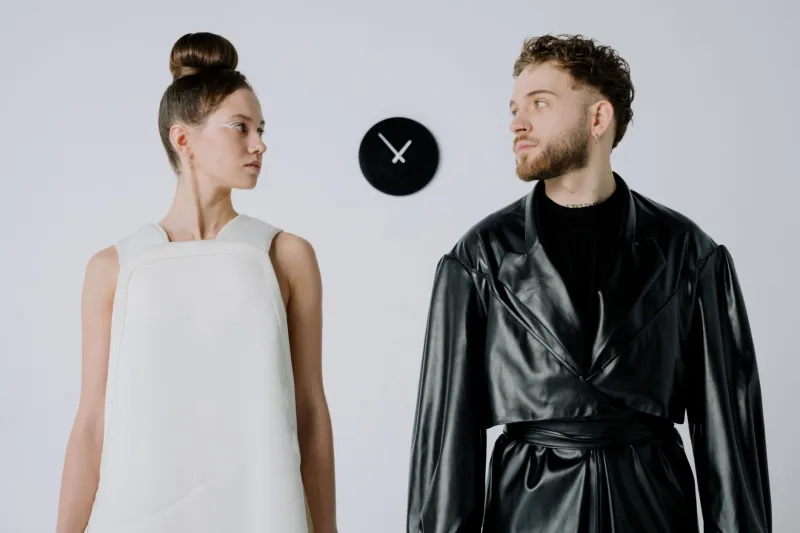
In architecture, the cantilever is a quiet act of defiance. A horizontal beam extends into open air, anchored at only one end, appearing to float without support. Frank Lloyd Wright's Fallingwater—perhaps the most famous example on American soil—seems to hover over its stream, its concrete terraces projecting impossibly over the water below. Visitors describe a moment of disorientation: the eye demands a column that simply isn't there.
Fashion produces the same disorientation. A sweeping train extends far beyond the body's natural perimeter. An exaggerated shoulder bag projects outward like a rigid arm. A sculptural peplum juts into space with no visible logic. These are the cantilevers of dress—pieces that refuse to respect the silhouette's edges. And like their architectural counterparts, they succeed or fail on a single principle: counterweight.
What Counterweight Actually Means
Every cantilevered structure relies on a hidden balancing force. The projecting element is heavy; the anchor must be heavier, or the whole thing tips. In dress, this calculus is visual rather than physical. A dramatic piece draws the eye outward and downward, and something elsewhere in the outfit must absorb that pull.
The classic mistake is symmetry of drama: pairing an oversized, projecting piece with another oversized, projecting piece. Two cantilevers without an anchor produce an outfit that reads as chaos rather than intention. The counterweight formula works in the opposite direction—where one element extends, everything else contracts.
The Three Working Formulas
Slim above, volume below. The most reliable configuration places the cantilever at the hem—a sweeping midi skirt, a flared train, a structured A-line that kicks away from the body—and anchors it with a fitted, unadorned top. A sleek turtleneck or a close-cut bodysuit acts as the buried foundation. The eye reads the narrow upper half as the anchor and the projecting lower half as the extension, and the proportion resolves as elegant rather than precarious.
Volume above, lean below. Invert the equation for shoulder-focused drama. A structured jacket with architectural sleeves, worn over a narrow column skirt or slim tailored trouser, borrows the logic of the inverted cantilever. The projecting shoulders read as a roofline; the clean vertical beneath them reads as the supporting pier. American workwear tradition understood this intuitively—the barn coat's generous cut only works because everything under it stays disciplined.
The projecting accessory. The most accessible cantilever is not a garment at all. An oversized structured bag that juts past the hip, a wide-brimmed hat that extends the shoulder line, a pair of geometric earrings that push past the jaw—all of these extend the body's boundary without altering the clothes. The counterweight rule still applies: one projecting accessory, worn against a simplified base, reads as sculpture. Three read as clutter.
Choosing Your Anchor
The counterweight piece should be quiet, but quiet is not the same as invisible. Fabric matters: smooth, matte, or finely textured materials recede, while anything with sheen, print, or surface dimension competes with the cantilever for attention. Color behaves similarly. A neutral anchor—black, ivory, camel, slate—lets the dramatic piece own the composition. A bold anchor turns the outfit into an argument between two loud voices.
Fit is the final discipline. The counterweight garment should sit close to the body's actual lines. Anything loose or draped muddies the visual math; the eye can no longer tell which element is the anchor and which is the extension, and the whole look loses its logic.
When to Break the Formula
Rules exist to be understood before they are bent. Once the counterweight instinct is second nature, you can introduce deliberate tension—an asymmetric drape, a second subtle projection—because you'll know exactly what you're risking and why. Runway fashion does this constantly, and the best street style in cities like New York and Los Angeles does it too: the wearer who pairs a trailing duster with a sculptural bag is not ignoring the formula but playing against it, with enough confidence to make the imbalance feel chosen.
Structure Is the Point
At its core, the cantilever approach is about understanding that every outfit is a load-bearing system. One element carries drama; the rest carry it. The result looks effortless precisely because the engineering is sound. Build your anchor first, extend with intention, and let one impossible piece do what cantilevers have always done—hold up more than seems possible, from seemingly nothing at all.