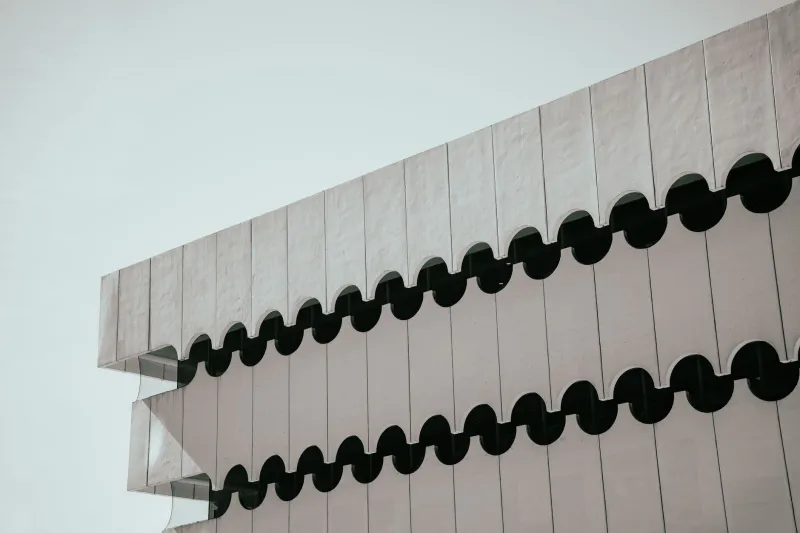
The Palette That Holds: Treating Color as Your Wardrobe's Structural Material

In architecture, nothing decorative is permitted until the structure can hold it. A cantilevered balcony, a glass curtain wall, a sweeping spiral staircase — all of it rests on foundations the visitor never sees. Wardrobes obey the same law. The most striking outfits you encounter on the streets of Chicago or Los Angeles are almost always anchored by one or two colors doing quiet, unglamorous work beneath the surface.
At Edifice, we think of these as load-bearing colors: the neutrals and near-neutrals that carry the visual weight of everything else you wear. Get them right, and even the boldest accent shade sits comfortably. Get them wrong, and the whole composition sags.
Why Neutrals Are Your Foundation Pour
Concrete cures before steel rises. In the same way, a functional palette cures around neutrals before accent colors are introduced. Think of charcoal, camel, ivory, navy, and stone gray not as boring defaults but as the rebar of your closet — invisible, essential, and load-rated for years of wear.
The American fashion landscape makes this easy to forget. Fast-cycle trends encourage a closet of one-off statement pieces with nothing in common, the sartorial equivalent of a house built from mismatched bricks. The remedy is disciplined: choose your structural neutrals first, and let every future purchase answer to them.
A Diagnostic: Identify Your Base Color
Not every neutral suits every person. Use this short framework — a kind of site inspection — to determine which foundation shade your wardrobe should be poured around.
1. Inspect the existing structure. Open your closet and count the dominant neutral across your five most-worn garments. That shade is not an accident; it is your de facto foundation, whether you planned it or not.
2. Test under natural light. Hold camel, charcoal, and navy near your face by a window. One will make your complexion read clearer and more rested; the others will dull it. The winner is a candidate for your primary load-bearing neutral.
3. Check the load path. Ask whether the shade connects your casual and formal layers. A true foundation color travels easily from a Saturday in Austin to a Monday meeting in Manhattan. If it only functions in one context, it is an accent pretending to be a foundation.
4. Verify compressive strength. Could you build three complete outfits around it — one for warm months, one for cold, one for occasions? If yes, it has the strength to bear weight. If no, demote it to an accent and keep inspecting.
Most people settle on one primary neutral and one secondary — say, charcoal supported by ivory, or camel supported by navy. Two structural shades, like two load-bearing walls, provide stability without crowding the floor plan.
Adding Accent Colors Without Overloading the Frame
Once the foundation is set, accent hues enter the picture — but buildings have occupancy limits, and so do outfits. A useful rule drawn from structural practice: one bold hue per composition, with a possible secondary accent kept small and subdued.
Consider these load-management principles:
-
Distribute the load. A saturated cobalt blazer over neutral trousers reads intentional. The same blazer over rust trousers and a green scarf asks one outfit to carry too many loads at once.
-
Mind the span. Large expanses of bold color bear more visual weight than small ones. A scarlet coat is a statement; a scarlet pocket square is a detail. Scale your accents to the structure beneath them.
-
Anchor bold hues to neutrals. Every vivid shade should touch a foundation color somewhere in the outfit. This is the visual equivalent of a beam meeting a column — the transfer point where drama becomes coherence.
-
Respect the 80/20 ratio. Roughly eighty percent foundation, twenty percent accent keeps an outfit stable. Exceed the ratio and you have not built anything; you have merely decorated until something gave way.
Building a Palette That Endures
The final test of any structure is time. A wardrobe built on load-bearing colors ages gracefully: neutrals weather well together, accents can be swapped season to season without demolishing the whole, and new purchases integrate instead of clashing. Before buying anything this year, ask the builder's question — what does this rest on? If the answer is your established foundation, pour the concrete. If not, the design belongs on paper, not on your body.
Structure first. Color second. That is how skylines get built, and it is how wardrobes do, too.