The New Silhouette: How Architectural Tailoring Is Dissolving the Lines Between Masculine and Feminine Dressing

Photo by Photo by Alex Wright on Unsplash on Unsplash
Every garment is, at its core, a decision about space. Where does the fabric sit on the body? Where does it depart from it? Which volumes are emphasized, which are suppressed, and which are left deliberately ambiguous? These are not merely technical questions — they are cultural ones. The choices a designer makes about structure, line, and proportion carry the accumulated weight of centuries of social expectation.
For most of Western fashion history, those expectations ran along a single, deeply entrenched axis: clothing was cut either to assert or to conceal, and the direction of that assertion or concealment was determined almost entirely by the wearer's presumed gender. The masculine suit compressed and squared. The feminine dress curved and softened. The silhouette was, in effect, a uniform — a way of announcing one's position within a system that had very little tolerance for ambiguity.
What is happening in contemporary tailoring — and what Edifice Clothing has built its design philosophy around — is something more architecturally interesting than a simple rejection of that system. It is a structural reimagining of what clothing can communicate when it is freed from the obligation to confirm.
Geometry as a Neutral Language
The most immediate tool in this reimagining is geometry. A seam placed at an unexpected angle does not read as masculine or feminine — it reads as precise. A panel cut that creates angular volume at the shoulder without relying on traditional padding does not announce gender; it announces intention. When the structural logic of a garment is derived from geometric principle rather than body-conforming convention, the result is something that sits differently in the cultural imagination.
This is where the architectural analogy becomes genuinely generative. A building's form is not typically understood through a gendered lens — we read it as bold or restrained, as heavy or light, as rigid or dynamic. Applying that same neutral, form-based reading to clothing opens up a vocabulary that does not require the wearer to be sorted before the garment can be appreciated.
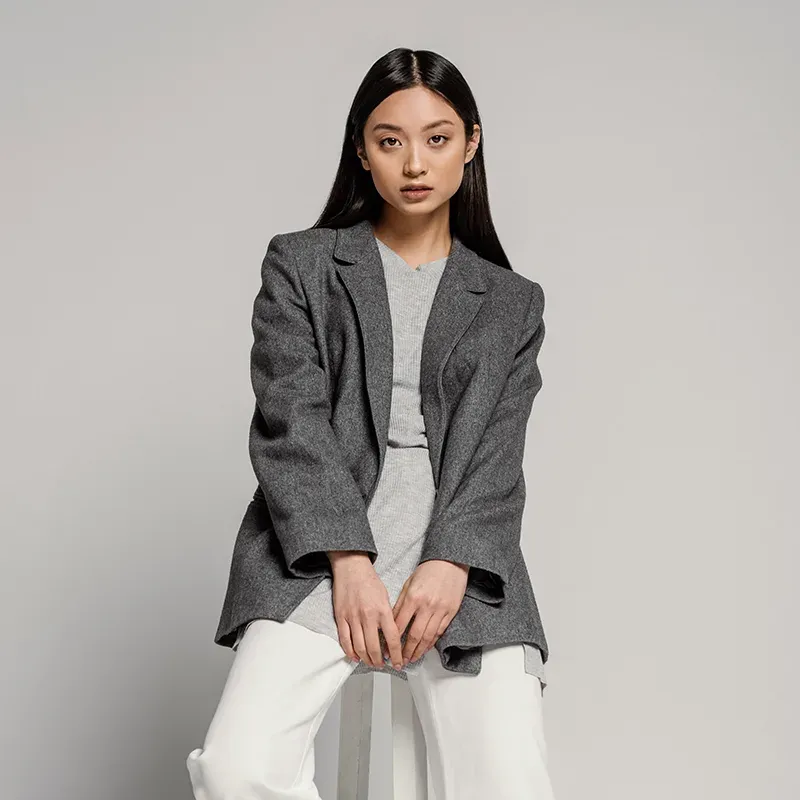
At Edifice, this approach manifests in pieces built around angular construction — blazers with unconventional lapel geometry, trousers with panel seaming that shifts the visual axis of the leg, outerwear that creates structured volume through cut rather than padding. None of these design decisions are predicated on who is wearing the piece. They are predicated on what the piece is doing structurally.
The Cultural Moment Behind the Movement
It would be disingenuous to discuss this design shift without acknowledging the cultural context that has made it both possible and necessary. American consumers, particularly those under forty, are increasingly resistant to the idea that clothing should serve as a declaration of binary gender identity. This is not a fringe position — it reflects a broad, measurable evolution in how a significant portion of the market thinks about self-presentation.
What is notable, however, is that the most durable response to this evolution in fashion has not come from the direction of maximalist gender-bending or theatrical subversion. It has come, more quietly and perhaps more powerfully, from the direction of structural precision. The argument being made by architecturally grounded tailoring is not that gender categories are irrelevant — it is that the construction of a garment need not be determined by them.
There is a meaningful difference between clothing that performs gender ambiguity as a statement and clothing that simply does not organize itself around gender as a primary design constraint. The former can feel like costume. The latter feels like freedom.
Sculptural Draping and the Body as Site
Beyond seaming and panel construction, sculptural draping offers another architectural strategy for expanding the expressive range of tailoring. Where conventional draping in both menswear and womenswear has historically followed predictable gravity-and-curve logic — fabric falling in ways that either emphasize or soften the body's existing contours — contemporary designers are using drape as a structural element in its own right.
A draped panel that creates a deliberate geometric shadow across the torso is not making a claim about the body beneath it. It is making a claim about form, about the relationship between weight and light, about the garment as an object with its own spatial presence. This is precisely the logic that governs architectural surface treatment — the idea that a material's behavior in space is itself a design statement, independent of the structure it covers.
For wearers navigating identity beyond conventional masculine or feminine presentation, this kind of structural neutrality is not merely aesthetically appealing. It is practically useful. A garment that creates its own geometry does not require the wearer's body to conform to a pre-existing template. It offers, instead, a framework — one that can be inhabited in as many ways as there are people wearing it.
Tailoring as Personal Architecture
The most compelling argument for architecturally rigorous tailoring as a vehicle for identity expression is, ultimately, the same argument that makes architecture itself so resonant as a human endeavor. We build structures to define space — to create environments that support specific kinds of life, that communicate specific values, that endure beyond the moment of their construction.
Clothing, at its best, does the same thing. A well-constructed garment defines a kind of space around the body — one that communicates intention, that supports a specific mode of self-presentation, that holds its form across time and context. When that space is defined by geometric precision and structural logic rather than by gender convention, it becomes something genuinely open: a framework that the wearer completes.
This is the design position Edifice Clothing occupies — not as a political stance, but as a design conviction. Rigorous construction, clean geometry, and sculptural form are not in service of any particular identity. They are in service of the wearer's capacity to express their own. The silhouette, when it is built this well, belongs entirely to the person inside it.